How nonprofits can retain donors through welcome sequences, impact emails, and re-engagement campaigns that turn one-time givers into loyal supporters.
TL;DR
Nonprofits often invest heavily in acquiring new donors, yet the real growth lies in what happens after the first gift. This blog takes a systems-level view of donor retention through email, combining behavioural research, industry benchmarks, and practical execution frameworks to show how communication, not just fundraising, drives long-term value. By mapping the complete post-donation journey, from immediate acknowledgement to re-engagement, it highlights how thoughtful, well-timed emails can transform one-time contributors into committed supporters, making retention a predictable and scalable outcome rather than a matter of chance.
The global average for first-time donor retention sits at just 19–21%, meaning roughly four in five new donors never give again. Email is the most cost-effective channel to change that.
A well-structured post-donation email journey, covering a welcome sequence, quarterly impact updates, and a re-engagement campaign, can lift retention rates to 60–70% or above.
Tone, timing, and specificity of impact matter far more than email volume. The benchmark is at least three stewardship emails for every one fundraising ask.
Your nonprofit just received a donation. Now what?
For most organisations, the answer is a receipt, a silence, and a year-end appeal. That pattern costs the sector dearly. The Fundraising Effectiveness Project (FEP), which tracks giving trends across tens of thousands of nonprofits globally, reports that only 19–21% of first-time donors make a second gift. Roughly four in five people who trusted your mission enough to give never come back.
The reason is rarely disillusionment. It is almost always neglect. In Penelope Burk's landmark research on donor behaviour, the single most common reason donors stop giving is this: they were never told what their gift actually did.
That is a communication failure. And email is the tool that fixes it.
At under $0.05 per contact, email delivers an estimated $36–42 return per dollar spent on marketing, and drives 28–33% of all online fundraising revenue for nonprofits. More importantly, it creates the kind of consistent, personal touchpoints that turn a one-time transaction into a long-term relationship.
This guide walks you through the four pillars of a donor retention email strategy: the welcome sequence, impact reporting, re-engagement campaigns, and the frequency and tone principles that hold all three together.
Why Donor Retention Is the Fundraising Problem Nobody Talks About Enough
Most nonprofits focus their energy on acquisition. They run campaigns, optimise donation pages, and measure new donor counts. Retention rarely gets the same attention, even though the economics are vastly more favourable.
Research by Adrian Sargeant at the Institute for Sustainable Philanthropy shows that a 10-percentage-point improvement in donor retention can increase lifetime value by up to 200%. Bloomerang's modelling puts this in concrete terms: improving retention from 41% to 51% among 5,000 donors, averaging $200 per gift, generates approximately $100,000 in additional annual revenue. That figure compounds every year.
According to D4NP's State of Nonprofits Digitization Report, more than 80% of nonprofits globally score low on digital maturity. Poor donor communication infrastructure is one of the most visible symptoms. The good news: you do not need a large team or a sophisticated tech stack to get this right. You need the right four-part email framework, set up once and automated to run itself.
The Post-Donation Email Journey at a Glance
Before getting into each component, it helps to see the full arc. The post-donation journey covers five stages:
Immediate (within minutes): Automated receipt with a heartfelt thank-you
Days 3–5: Welcome email introducing the mission and community
Days 7–10: Impact story showing the donor's gift at work
Days 14–21: Engagement deepener inviting the donor into the relationship
6–9 months of inactivity: Re-engagement sequence before the donor lapses
Quarterly impact updates run throughout the relationship, independent of this sequence. Think of them as the ongoing proof that the donor made the right decision.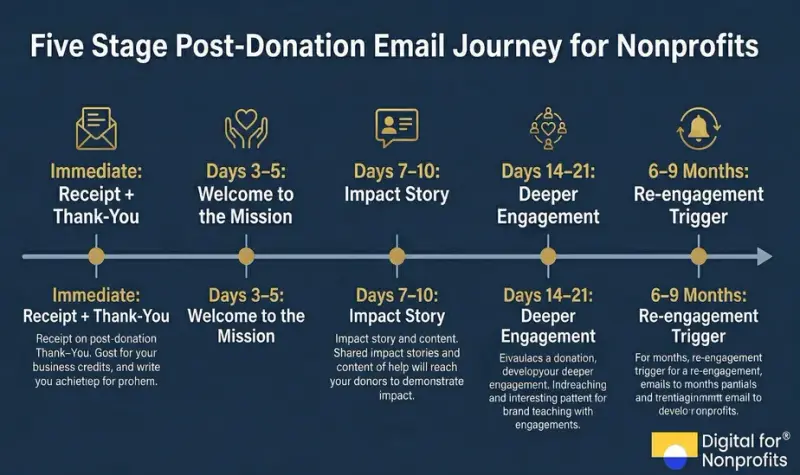
Building Your Welcome Sequence
Welcome emails achieve open rates of 50–70%, roughly three times the rate of regular campaigns). That window of high attention is your most valuable moment as a fundraiser. Most organisations waste it on a generic receipt.
NextAfter's research shows that donors who receive a full welcome series deliver 2–3 times the 12-month value of donors who receive only a receipt. Bloomerang reports that organisations with a structured sequence see 25–50% improvements in first-time donor retention. These are not marginal gains. They are the difference between a sustainable donor base and a leaking bucket.
Here is how to build a four-email sequence that works.
Email 1: The Thank-You That Actually Means Something
Send this within minutes of the gift, automatically triggered by your CRM or donation platform.
Include the donor's first name, the exact gift amount, and a single, specific impact statement. "Your $75 provides clean water for three families this month" is infinitely more powerful than "your generous donation makes a difference." Add a real photo. Sign it from a person, not a department. Include no second ask.
This email answers one question the donor is quietly asking: "Did I make the right decision?" Answer it clearly and warmly, and you significantly increase the probability of a second gift.
Email 2: Welcome to the Mission
Send this 3–5 days after the gift, once the receipt has landed and the donor's inbox has had a moment to breathe.
This email is about belonging. Share the origin story of your organisation, or a brief narrative from your founder or a programme lead. Explain what you are working toward in plain language. Let the donor know what kinds of updates they will receive and how often. The goal is to move them from "I gave money" to "I am part of something."
Include no ask. This is a relationship email, not a fundraising email.
Email 3: Show the Impact in Action
Send this 7–10 days after the gift. This is the email that closes the loop between donation and outcome.
Lead with a single beneficiary story. Name the person, describe the specific change your work enabled, and tie it directly to the donor's gift. Campaign Monitor data shows that personalised emails using the donor's name and gift details produce 5.7 times higher revenue per email than broadcast messages. The more specific you are, the more real it feels.
Organisations like Save the Children have demonstrated what this looks like at scale: automated email sequences that spotlight specific children and communities, turning a donation into a personal connection rather than an abstract transaction.
Email 4: Invite Them Deeper
Send this 14–21 days after the gift. This is where one-time donors begin to become community members.
Offer a low-pressure next step. That could be following your organisation on social media, reading a case study, completing a short survey about what drew them to your cause, or joining a newsletter. If your donor base trends toward high engagement, you can include a soft recurring-giving invitation framed around a specific impact outcome ("A monthly gift of $25 funds one programme session every month").
The underlying message is this: your gift was not a transaction. It was the beginning of something.
Impact Reporting Emails: Turning Numbers Into Narratives
Approximately 53% of donors cite poor communication, specifically the lack of information about what their donation achieved, as the reason they stopped giving. Impact reporting is not a nice-to-have. It is the primary retention lever available to any nonprofit, at any size, in any country.
Organisations that send regular, structured impact updates routinely achieve donor retention rates of 60–70% or above, compared to the sector average of 43–46%. That gap represents years of additional revenue.
The Story-Stat-Forward Look Structure
The most effective impact email follows a three-part structure:
One story (60% of the email): Lead with a single named individual or community. Describe the situation before your programme, the change your work enabled, and where that person is now. This is not a case study. It is a story, told with the same warmth you would bring to a conversation over coffee.
One stat (25%): After the story, ground it in scale. "Because of donors like you, we reached 1,200 families across three districts this quarter." Specific numbers signal accountability and transparency.
One forward look (15%): Close by inviting the donor into what comes next. "Next quarter, we are expanding to two new communities. Your continued support makes that possible." This creates a reason to stay engaged, not just a reason to feel good about what has already happened.
[Insert Image 2: Impact Email Anatomy]
Language matters here. Write every sentence from the donor's perspective. "Because of you, 347 families have clean water" lands differently, and more powerfully, than "Our programme served 347 families." The donor is the hero of this story. Your organisation is the vehicle.
What Not to Include
Do not include a donation ask in an impact email. Mixing solicitation with stewardship trains donors to expect a pitch in every message, and erodes the trust you are trying to build. Do not list more than three to five statistics in a single email. Do not use stock photography where real images from the field exist. And do not send the same update to every donor regardless of which programme they funded.
Frequency: Quarterly Beats Annual
An annual impact report arriving nine months after a gift is too late to prevent attrition. Send quarterly impact updates as the baseline. Supplement these with an immediate post-gift acknowledgement, a 30-day "first impact" email, and milestone-triggered updates when specific projects reach completion.
Re-Engagement Campaigns: Winning Back Donors Before It Is Too Late
The industry standard definition of a lapsed donor is someone who has not given in the past 12–24 months, a threshold used by the Fundraising Effectiveness Project, Bloomerang, and Network for Good. But the best re-engagement work begins before donors technically lapse.
Recency is the strongest predictor of reactivation success. A donor inactive for 6–9 months is far more recoverable than one who has been silent for two years. FEP data shows recaptured donor rates of just 4–6% across the sector. But with targeted campaigns focused on recently lapsed donors (12–18 months of inactivity), reactivation rates of 10–15% are achievable.
Start your re-engagement sequence at the 6–9 month mark, not the 12-month mark. The earlier you reach out, the better your odds.
The Three-Email Win-Back Sequence
Email 1: Reconnection (Month 6–7 of inactivity)
This email is warm and has no ask. Acknowledge that some time has passed. Share one compelling update or a brief impact story from the period they have been away. Link to your impact page, not a donation page. Subject lines like "We miss you, [Name]" or "[Name], a lot has changed" consistently generate the highest open rates in win-back campaigns.
Email 2: Impact Reminder (Weeks 2–3 of the sequence)
Reference their giving history directly. "The last time you gave, here is what happened." Share two or three major accomplishments and include a beneficiary testimonial if available. Consider embedding a short survey asking what they care about most. This email tells donors they were remembered. That matters enormously.
Email 3: A Clear Invitation (Weeks 4–6 of the sequence)
Be direct but respectful. Present a specific giving opportunity, ideally with a matched gift or a campaign milestone if one actually exists. Offer options: give again, update their communication preferences, or unsubscribe with no hard feelings. Subject lines like "Before we say goodbye" or "One more thing before we go" typically generate the highest response rates in the final email of a win-back sequence.
When to Sunset Unresponsive Contacts
Continuing to email unresponsive contacts damages your sender reputation with email providers and lowers your overall open rates. Gmail and Yahoo's 2024 sender guidelines require complaint rates below 0.3%. The recommended approach is to reduce email frequency at 6–9 months of inactivity, deploy the win-back sequence at 9–12 months, shift to annual-only communication if the sequence fails, and remove contacts from your email list entirely at 18–24 months while retaining them in your CRM for direct mail. Top-performing nonprofits actively prune 10–20% of their list annually
Email Frequency and Tone: Getting the Balance Right
The nonprofits sent an average of roughly59 emails per subscriber per year, approximately five per month. That figure skews high because of large advocacy and political organisations. For most nonprofits, 1–2 emails per week (4–8 per month) reflects the engagement sweet spot identified by Campaign Monitor. Organisations with limited content capacity should start at two emails per month and scale based on engagement signals.
The most widely cited guideline in nonprofit email marketing is the80/20 rule: 80% of emails should deliver value while 20% include a fundraising ask. Alternatives include the 3:1 rule, which requires three stewardship emails for every one appeal. Either framework prevents the over-solicitation that 58% of donors cite as their primary reason for disengaging
Tone shifts depending on the email type:
Appeal emails should be urgent, story-driven, and focused on a single clear call to action.
Impact emails should be warm, celebratory, and gratitude-led. The donor is being celebrated, not sold to.
Newsletters should be informational and conversational, offering updates, educational content, and a window into your organisation's world.
Re-engagement emails should assume goodwill and offer a low-pressure path back into the relationship.
Getting Started: Tools and Setup
You do not need an expensive platform to build this system. Here are the tools most nonprofits use:
Mailchimp is the most widely adopted platform among small-to-mid-sized nonprofits globally. Its free plan covers up to 500 contacts with 1,000 sends per month. Verified nonprofits receive a 15% discount on paid plans. Brevo (formerly Sendinblue) offers a free tier of 300 emails per day with unlimited contacts, making it a strong option for organisations with larger lists and tighter budgets. ActiveCampaign and HubSpot offer more advanced segmentation and automation, with nonprofit discounts available through TechSoup.
If your nonprofit is eligible for Google for Nonprofits, you receive free Google Workspace accounts (Gmail, Drive, Calendar, Meet) with professional email infrastructure at no cost. Google Workspace covers your day-to-day email operations, but you will still need a dedicated email marketing platform for donor campaigns and automation. You can pair the two seamlessly.
The basic automation setup is the same across most platforms: set a trigger (a new donation or subscription), build your email sequence with wait steps between each send, write and design your content using the platform's editor, and activate. The welcome sequence, impact update, and re-engagement campaign described in this guide can all be built in an afternoon and run automatically from that point forward.
For nonprofits looking to connect their donor acquisition and retention strategy, the Google Ad Grant ($10,000 per month in free search advertising for eligible nonprofits) is a powerful way to bring new supporters into the email journey. Visitors who arrive via Ad Grant campaigns can be converted to email subscribers, fed into the welcome sequence, and nurtured toward long-term giving.
D4NP helps nonprofits activate and maximise their Google for Nonprofits benefits, including Google Workspace and Ad Grants setup, as part of a broader digital strategy. Explore our tech grants advisory.
Conclusion
Every nonprofit, regardless of size, geography, or budget, can build a donor retention email system. The tools are affordable, many are free, and the framework in this guide can be automated to run without manual effort once it is in place.
The opportunity is significant. A first-time donor retention rate of 19–21% is not a ceiling. It is a starting point. With a four-email welcome sequence, quarterly impact updates structured around the story-stat-forward-look framework, and a re-engagement trigger set at six to nine months, retention rates of 60–70% are within reach for any organisation willing to treat stewardship as a system rather than an afterthought.
Your donors gave because they believed in your mission. The email journey you build after that gift tells them whether they were right to.
If you want support building this system, including connecting it to your Google Ad Grant strategy to grow your list at no cost, D4NP works with nonprofits at every stage of digital maturity. Start with a free tech assessment here.