A practical guide for nonprofits deciding when the free $10,000/month grant is enough and when investing in paid campaigns makes more sense.
Your nonprofit qualified for the Google Ad Grant. You set up your campaigns, your ads started running, and traffic picked up. Then fundraising season arrived. You wanted to re-engage the 94% of website visitors who left without donating. You tried bidding on your most important keywords. Your ads kept losing to paying competitors. You had $10,000 in free credits and could not quite reach the donors who mattered most.
This is the reality many NGOs face. The Google Ad Grant is one of the most valuable free resources available to nonprofits. According to D4NP's State of Nonprofits Digitization Report, 83% of Indian NGOs are not using it, forfeiting the equivalent of Rs 1 crore per year in free advertising. But for the NGOs that do activate it, questions quickly emerge: Is the Grant enough on its own? When does it make sense to invest in paid campaigns? Can you run both at the same time?
This guide answers all of that.
What Google Ad Grants Actually Gives Your NGO
Google Ad Grants is a program that provides eligible nonprofits with $10,000 per month or $120,000 per year in in-kind Google Search advertising credits with no cash out of pocket required.
To qualify, your organisation needs a valid tax-exempt status. In India, this typically means 80G/12A registration and a valid FCRA certification. You also need verification through Goodstack, Google's official nonprofit verification partner since August 2023. Government bodies, hospitals, and academic institutions are not eligible.
The Grant runs on Search campaigns only. Your ads appear when people search for terms related to your cause. If someone types "donate to child education India" or "support women's rights NGO," your ad can appear in Google results.
Learn how to apply for Google Ad Grants through D4NP's Google for Nonprofits programme.
The monthly budget does not roll over. Unused credits are forfeited at the end of each month. Well-managed Grant accounts spend $5,000 to $9,000/month on average. If your account is well-optimised, the Grant alone can drive thousands of qualified visitors to your website every month at zero media cost.
The Real Limitations of Google Ad Grants
The grant is a powerful tool. But to use it well, your NGO needs to understand exactly what it can't do.
Your ads show paid ads below
In Google's auction system, paid advertisers and grant accounts do not compete on equal terms. Grant ads enter a separate auction that runs after paid ads have already claimed the top positions. In practice, that means for high-competition keywords — think "donate to climate change" or "child education fund" — paid advertisers will almost always appear first. Your grant ads may not appear at all.
For lower-competition, longer-tail keywords (like "how to help underprivileged children in Delhi" or "volunteer with a women's literacy NGO"), grant accounts can perform very well. The key is choosing keywords where paid competition is low.
Only search campaigns. No Video, Display, or Remarketing Ads inventory
The Google Ad Grant is restricted to text-based search ads on Google.com. You cannot run:
YouTube video ads
Display banner ads on third-party websites
Gmail ads
Shopping campaigns
Remarketing campaigns that follow previous website visitors
If your NGO runs an annual fundraising campaign that needs video storytelling, or if you want to re-engage people who visited your donation page but didn't complete a gift, the grant alone won't get you there.
A 5% CTR requirement every month
CTR (click-through rate) is the percentage of people who see your ad and click on it. Google requires grant accounts that are not exclusively using Smart Campaigns to maintain a minimum 5% CTR, measured at the account level, not per individual keyword or campaign. Fail to meet this threshold for two consecutive months, and your account will be temporarily deactivated.
This is a meaningful operational burden. The average Google Ad Grants account only spends around $300 of its $10,000 monthly budget because most nonprofits aren't actively managing their accounts. Accounts that are well-managed, with tight keyword targeting, relevant ad copy, and aligned landing pages, can regularly hit the full $10,000 in spend and maintain strong CTR. But it requires consistent attention.
Keyword restrictions that limit what you can bid on
Grant accounts cannot use single-word keywords (with limited exceptions), keywords with a quality score below 3, or branded competitor terms. This is designed to keep the grant mission-aligned and prevent irrelevant traffic. But it does mean some of your most valuable keywords, the ones where donation intent is clearest, may not be available to you in a grant account.
Budget doesn't roll over
Unused grant credits expire at the end of each month. If your NGO doesn't have the infrastructure to run active campaigns, the grant goes to waste. This is exactly what D4NP's research documents: most eligible NGOs either aren't activated, or they're activated and underutilizing the grant because account management is inconsistent.
What Paid Google Ads Unlock That the Grant Cannot
Paid Google Ads removes every restriction listed above. With a paid account, your NGO gains access to:
The full campaign library. Search, Display, Shopping, YouTube, full Performance Max (including YouTube, Gmail, Discover, and the entire Google Display Network), Demand Gen, and App campaigns. You can reach your audience on every surface Google offers.
Remarketing and retargeting. Remarketing and retargeting represent one of the single biggest advantages of paid ads for nonprofits. You can build audiences of people who visited your donation page without completing a gift, watched 75% of your YouTube video, or clicked through to your volunteer sign‑up page and left. Because these are warm audiences, paid Display remarketing campaigns often run at very low CPCs, typically in the low‑ to mid‑double‑digit rupee range, making them one of the most cost‑efficient ways to convert interested visitors into donors or supporters.
No bid caps, no keyword restrictions. Compete for the exact terms where your mission matters most, at bids that can actually win top positions.
No CTR requirements. You face no compliance thresholds, no risk of account deactivation, and no monthly monitoring burden beyond normal campaign management.
Visual storytelling at scale. YouTube is India's largest video platform. For nonprofits whose impact is visible and emotional, video ads let donors see the work, not just read about it.
Google Ad Grants vs Paid Google Ads: Key Differences
When Should Your Nonprofit Consider Paid Google Ads?
Paid ads aren't for every NGO at every stage. But there are specific situations where they deliver results that the grant simply cannot match.
You need to win high-competition donation keywords. Search terms like "donate now," "donate to children's education," or "support disaster relief" attract heavy competition from large commercial advertisers and well-funded NGOs. Grant accounts rarely win these auctions. A modestly paid budget targeted at your most important giving-season keywords can dramatically improve your results during your most critical fundraising moments.
You're running a time-sensitive campaign. Disaster response, year-end giving (Daan Utsav in India, Giving Tuesday globally), or a specific fundraising drive all have narrow windows. Paid ads let you scale spend precisely when it matters, then pull back. The grant doesn't have that flexibility.
You want remarketing. Someone visited your "Sponsor a Child" page and left without donating. A paid remarketing campaign lets you follow up with a targeted ad. Grant accounts don't have this capability. Remarketing consistently delivers some of the highest returns of any digital advertising tactic, and nonprofits that use it see meaningful improvements in donation completion rates.
You need video or display formats. If your NGO has compelling beneficiary stories, a fundraising film, or visual campaign assets, paid YouTube and Display campaigns are the only way to run them through Google. The grant is search-text only.
Your grant account has plateaued. If you're already maximizing your grant spend with well-optimized campaigns and you want to grow further, paid ads are the natural next step.
AI Overviews are reducing your informational search traffic. As of early 2026, more than 91% of queries that trigger Google's AI Overviews are informational, exactly the type of traffic Grant accounts rely on. Diversifying into Display, YouTube, and Demand Gen provides coverage as the search landscape shifts.
See how D4NP supports nonprofits across the full Google for Nonprofits ecosystem.
Budget Considerations for Nonprofits
The word "paid" doesn't mean expensive. But it does mean intentional. Before deciding how much to spend, start with your fundraising goal and work backwards.
The most useful metric here is ROAS (return on ad spend). ROAS tells you how much revenue your ads generate for every dollar you invest. A ROAS of 2 means every $1 in ad spend brings in $2 in donations. When you're just starting with paid ads, use a conservative ROAS of 2 as your planning benchmark.
The back-calculation works like this: if your campaign goal is to raise $1,000 in donations, a 2x ROAS means you can justify up to $500 in ad spend to hit that target. If your goal is $5,000 in donations, your budget ceiling at 2x ROAS is $2,500. This keeps your paid campaigns grounded in real fundraising math, not guesswork.
As your campaigns mature and you gather more conversion data, your actual ROAS will tell you whether to scale up, pull back, or shift budget between campaigns. Starting conservatively protects your NGO from overspending before you understand what's working.
The two accounts run in entirely separate auctions. As Google's own program FAQ confirms, grant ads and paid ads from the same organization do not compete against each other. Running both won't inflate your own costs or cancel out your grant activity.
The Hybrid Strategy: Using Google Ad Grants and Paid Ads Together
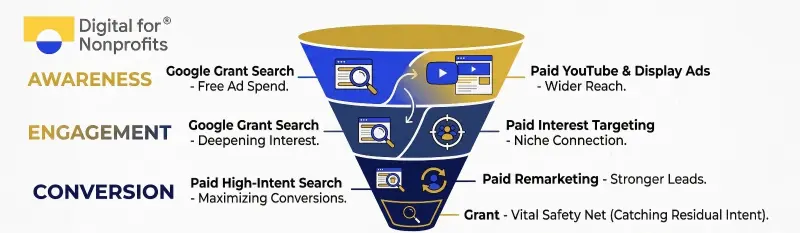
You do not have to choose between the Grant and paid advertising. Google explicitly supports running both simultaneously. The two accounts operate in separate auctions and do not compete with each other.
The most effective nonprofits don't choose between the grant and paid ads. They use both, each doing the job it's best suited for.
Think of it as a two-layer digital advertising system:
Layer 1: The Ad Grant: Always-on awareness.
Use your grant account for top-of-funnel visibility. Target informational and mid-intent keywords: people learning about your cause, researching NGOs, looking for volunteer opportunities, or exploring ways to help. This is where grant accounts thrive. The competition is lower, CTR requirements are easier to meet, and you're building a steady stream of mission-aligned visitors to your website at zero cost.
Layer 2: Paid Ads: High-intent conversion and remarketing.
Reserve your paid budget for bottom-of-funnel campaigns. Target donation-specific keywords where competition is high. Run remarketing to re-engage past visitors. Launch short-burst campaigns for your most important fundraising moments. Use video and display for your annual campaigns or major appeals.
The data flywheel.
Here's a practical benefit that most NGOs overlook: the keyword and audience data from your grant account is enormously valuable for your paid campaigns. You learn which search terms drive the most engaged visitors, which landing pages convert, and which audiences respond. That insight directly informs where your paid budget should go, so you're not guessing.
A suggested approach for NGOs new to paid ads:
Activate and optimize your Google Ad Grant first. Run it for 3–6 months.
Identify your top-performing keywords and landing pages from grant account data.
Launch a small paid campaign ($200–300/month) targeting your highest-intent keywords and a remarketing audience built from your grant traffic.
Scale your paid spend based on what the data shows, not based on assumptions.